Radeon RX 7700 XT & Radeon RX 6750 XT share many similarities, but there are also important differences, such as quality, performance, features, design, and connectivity. If you want the best one between them, I Would recommend the Radeon RX 7700 XT rather than the Radeon RX 6750 XT.
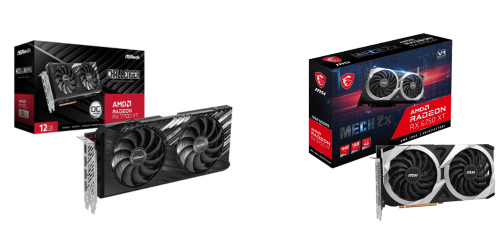
Why Do I Recommend The Radeon RX 7700 XT?
- The Radeon RX 7700 XT features the RDNA 3 architecture for higher performance per watt and improved efficiency in modern games and workloads, while the Radeon RX 6750 XT uses the older RDNA 2 architecture.
- Radeon RX 7700 XT has a higher 54 compute unit count for stronger parallel processing and better performance in GPU-intensive tasks, whereas the Radeon RX 6750 XT comes with fewer compute units.
- It includes dedicated AI accelerators to improve performance in AI-assisted workloads and future software features, while the Radeon RX 6750 XT does not include AI acceleration hardware.
- The Radeon RX 7700 XT supports DisplayPort 2.1 to enable higher refresh rates and resolutions on next-generation monitors, while the Radeon RX 6750 XT is limited to DisplayPort 1.4a.
- Radeon RX 7700 XT supports hardware AV1 encoding for more efficient video streaming and content creation with lower bandwidth usage, whereas the Radeon RX 6750 XT supports AV1 decoding only.
- It uses a chiplet-based GPU design to improve scalability and manufacturing efficiency, while the Radeon RX 6750 XT relies on a traditional monolithic die design.
- The Radeon RX 7700 XT features improved ray tracing accelerators for smoother ray-traced lighting and reflections in supported games, whereas the Radeon RX 6750 XT has earlier-generation ray tracing hardware.
- Radeon RX 7700 XT includes newer multimedia and display engines for better support of modern codecs and multi-display setups, while the Radeon RX 6750 XT uses an older display and media engine.
Maybe the Radeon RX 6750 XT can make you comfortable because it’s a little bit cheaper than the Radeon RX 7700 XT. But you have to compromise all the above-mentioned features. Now the Decision is Yours. I hope it was helpful to choose the right one.
Side-by-Side Comparison
| Feature | Radeon RX 7700 XT | Radeon RX 6750 XT |
| Architecture | RDNA 3 | RDNA 2 |
| Manufacturing Node | TSMC N5+ N6 | TSMC N7 |
| Die Design | Chiplet | Monolithic |
| Compute Units (CUs) | 54 | 40 |
| Stream Processors | 3456 | 2560 |
| Ray Accelerators | 54 | 40 |
| AI Accelerators | 216 | N/A |
| Texture Units (TMUs) | 216 | 160 |
| Render Output Units (ROPs) | 96 | 64 |
| DisplayPort Version | DisplayPort 2.1 | DisplayPort 1.4a |
| AV1 Hardware Encode | Yes | No |
| Price | Check Radeon RX 7700 XT Price | Check Radeon RX 6750 XT Price |
Common Features
| Feature | Radeon RX 7700 XT | Radeon RX 6750 XT |
| AMD Radeon Series | Yes | Yes |
| Discrete Desktop GPU | Yes | Yes |
| PCI Express Interface | PCIe 4.0 | PCIe 4.0 |
| GDDR6 Memory Type | Yes | Yes |
| Memory Capacity | 12 GB | 12 GB |
| Memory Speed | 18 Gbps | 18 Gbps |
| DirectX Support | DirectX 12 Ultimate | DirectX 12 Ultimate |
| Vulkan Support | Yes | Yes |
| Hardware Ray Tracing | Yes | Yes |
| AMD FidelityFX Support | Yes | Yes |
| AMD Radeon Software | Yes | Yes |
| AMD Smart Access Memory | Yes | Yes |
| Multi-Monitor Support | Yes | Yes |
| VR Ready | Yes | Yes |
| 8-Pin Power Connectors | 2×8-pin | 2×8-pin |
| Display Outputs | HDMI + DisplayPort | HDMI + DisplayPort |
| FreeSync Support | Yes | Yes |
| Price | Check Radeon RX 7700 XT Price | Check Radeon RX 6750 XT Price |
FAQ
Is the Radeon RX 7700 XT newer than the Radeon RX 6750 XT? Do both Radeon RX 7700 XT and Radeon RX 6750 XT have the same VRAM capacity? Are both GPUs suitable for 1440p gaming? Do both graphics cards support hardware ray tracing? Is PCIe 4.0 supported on both GPUs? Do both cards use the same type of power connectors? Are both GPUs compatible with AMD FreeSync monitors? Do both GPUs support DirectX 12 Ultimate features? Is AMD FidelityFX supported on both graphics cards? Can both GPUs be used for VR gaming? Do both GPUs use GDDR6 memory? Are driver updates shared between the two GPUs? Do both cards support multi-monitor setups? Is the power consumption similar between the two GPUs? Are both GPUs compatible with modern AMD and Intel platforms? |