JBL Boombox 3 Wifi & JBL Boombox 3 share many similarities, but there are also important differences, such as quality, performance, features, design, and connectivity. If you want the best one between them, I Would recommend the JBL Boombox 3 Wifi rather than the JBL Boombox 3.
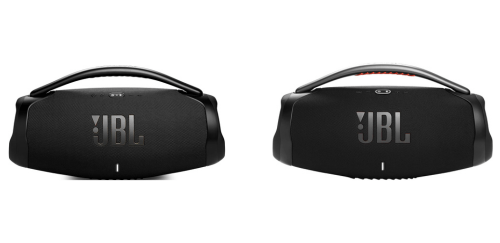
Why Do I Recommend The JBL Boombox 3 Wifi?
- The JBL Boombox 3 Wi-Fi has built-in Wi-Fi for direct high-bitrate music streaming without a phone connection, while the JBL Boombox 3 uses Bluetooth only.
- JBL Boombox 3 Wi-Fi supports Apple AirPlay 2 for seamless streaming from iOS and macOS devices with better stability across a home network, whereas the JBL Boombox 3 does not support AirPlay.
- It supports Chromecast built-in to stream audio directly from supported apps with consistent quality and longer range, while the JBL Boombox 3 lacks Chromecast support.
- The JBL Boombox 3 Wi-Fi includes Spotify Connect for native in-app playback control without Bluetooth compression, while the JBL Boombox 3 streams Spotify only over Bluetooth.
- JBL Boombox 3 Wi-Fi supports true multi-room audio for synchronized playback across multiple Wi-Fi speakers in different rooms, whereas the JBL Boombox 3 is limited to single-speaker Bluetooth use.
- It comes with over-the-air firmware updates via Wi-Fi for faster and more reliable software improvements, while the JBL Boombox 3 updates firmware through a Bluetooth app connection.
- The JBL Boombox 3 Wi-Fi features lower-latency network streaming for improved audio sync when playing video or TV content, whereas the JBL Boombox 3 relies on higher-latency Bluetooth transmission.
- JBL Boombox 3 Wi-Fi supports home network control via a dedicated Wi-Fi ecosystem app for remotely managing playback and rooms, while the JBL Boombox 3 uses only basic Bluetooth device control.
Maybe the JBL Boombox 3 can make you comfortable because it’s a little bit cheaper than the JBL Boombox 3 Wifi. But you have to compromise all the above-mentioned features. Now the Decision is Yours. I hope it was helpful to choose the right one.
Side-by-Side Comparison
| Feature | JBL Boombox 3 Wifi | JBL Boombox 3 |
| Wi-Fi | Yes | No |
| Wi-Fi bands | 2.4GHz / 5GHz | N/A |
| Wi-Fi standard | 802.11 a/b/g/n/ac/ax | N/A |
| AirPlay | Yes | No |
| Chromecast built-in | Yes | No |
| Spotify Connect | Yes | No |
| Alexa Multi-Room | Yes | No |
| Dolby Atmos music | Yes | No |
| Streaming (direct) | Yes | No |
| Multi-room playback | Yes | No |
| Bluetooth + Wi-Fi switching | Yes | Bluetooth only |
| Companion app | JBL One | JBL Portable |
| Bluetooth transmitter power | <12 dBm | ≤9 dBm |
| Bluetooth frequency range | 2.4–2.4835 GHz | 2.402–2.480 GHz |
| Charging time | 4.5 h | 6.5 h |
| Firmware updates | OTA | App |
| Voice ecosystem control | Supported | Not supported |
| Price | Check Boombox 3 Wifi Price | Check JBL Boombox 3 Price |
What Common Both Can Do?
- Speaker type: Both models are designed as large portable speakers intended for indoor and outdoor use. This makes them suitable for parties, gatherings, and travel where high volume and durability are needed.
- Sound signature: Each speaker uses JBL Original Pro Sound tuning. This ensures a familiar JBL sound profile with strong bass, clear mids, and crisp highs across different music genres.
- Driver configuration: Both speakers use a 3-way speaker system. This design separates lows, mids, and highs for better clarity and balanced sound at high volumes.
- Woofer size: Each model includes a racetrack-shaped subwoofer. This allows deeper bass performance while keeping the cabinet size manageable.
- Midrange drivers: Both speakers include dual midrange drivers. This improves vocal clarity and instrument separation during complex tracks.
- Tweeters: Each model uses two tweeters. This enhances high-frequency detail and helps maintain clarity at louder listening levels.
- Maximum output power: Both speakers are rated at the same total output power. This means overall loudness capability is equivalent between the two models.
- Frequency response: Each speaker covers the same frequency range. This ensures similar bass depth and treble extension when listening to music.
- Bluetooth connectivity: Both models support Bluetooth wireless playback. This allows easy pairing with smartphones, tablets, and other Bluetooth-enabled devices.
- Bluetooth version: Each speaker uses Bluetooth 5.3. This provides stable connections, efficient power usage, and improved compatibility with newer devices.
- PartyBoost support: Both speakers support JBL PartyBoost. This allows pairing with other compatible JBL speakers for synchronized playback.
- Battery capacity: Each model uses a high-capacity internal battery. This supports long listening sessions without frequent recharging.
- Playback time: Both speakers are rated for up to 24 hours of use. This makes them suitable for all-day events and extended outdoor use.
- USB charging (power bank): Each speaker can charge external devices via USB. This adds convenience when using the speaker outdoors or while traveling.
- Water resistance: Both speakers are rated IP67. This means they can handle water exposure such as rain or splashes without damage.
- Dust resistance: The shared IP67 rating also covers dust protection. This makes both models suitable for beach or outdoor environments.
- Carry handle: Each speaker includes an integrated metal handle. This improves portability despite the speaker’s large size.
- Cabinet material: Both speakers use a reinforced metal grille and rubberized housing. This improves durability and protects internal components.
- Orientation: Both models are designed for horizontal placement. This ensures optimal sound dispersion and stability during use.
Common Features
| Feature | JBL Boombox 3 Wifi | JBL Boombox 3 |
| Speaker type | Portable Bluetooth speaker | Portable Bluetooth speaker |
| Sound signature | JBL Original Pro Sound | JBL Original Pro Sound |
| Driver configuration | 3-way system | 3-way system |
| Woofer size | 1 × racetrack subwoofer | 1 × racetrack subwoofer |
| Midrange drivers | 2 × midrange | 2 × midrange |
| Tweeters | 2 × tweeters | 2 × tweeters |
| Maximum output power | 180 W | 180 W |
| Frequency response | 40 Hz – 20 kHz | 40 Hz – 20 kHz |
| Bluetooth connectivity | Yes | Yes |
| Bluetooth version | Bluetooth 5.3 | Bluetooth 5.3 |
| PartyBoost support | Yes | Yes |
| Battery capacity | 10,000 mAh class | 10,000 mAh class |
| Playback time | Up to 24 hours | Up to 24 hours |
| USB charging (power bank) | Yes | Yes |
| Water resistance | IP67 | IP67 |
| Dust resistance | IP67 | IP67 |
| Carry handle | Integrated metal handle | Integrated metal handle |
| Cabinet material | Metal grille + rubber housing | Metal grille + rubber housing |
| Orientation | Horizontal | Horizontal |
| Price | Check Boombox 3 Wifi Price | Check Boombox 3 Price |
FAQ
What is the main difference between JBL Boombox 3 Wi-Fi and JBL Boombox 3? Do both JBL Boombox 3 models sound the same? Can both speakers be used outdoors without worry? Is battery life the same on both models? Do both JBL Boombox 3 versions support Bluetooth? Can JBL Boombox 3 Wi-Fi work without an internet connection? Do both speakers support PartyBoost? Can both models charge other devices? Are the physical size and weight the same? Do both speakers use the same mobile app? Can either model be used with a TV or computer? Does the Wi-Fi version support multi-room audio? Are firmware updates handled the same way on both models? Do both speakers have built-in microphones for calls or voice assistants? Which model is better for home use versus travel? |