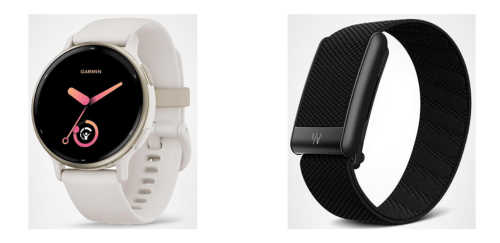
Garmin Vivoactive 5 & Whoop share many similarities, but there are also important differences, such as quality, performance, features, design, and connectivity. If you want the best one between them, I Would recommend the Garmin Vivoactive 5 rather than the Whoop.
Why Do I Recommend The Garmin Vivoactive 5?
- The Garmin Vivoactive 5 has a built-in AMOLED touchscreen display for viewing live workout metrics, notifications, and health data directly on the wrist, whereas Whoop has no display and requires checking all information through a smartphone app.
- Garmin Vivoactive 5 has built-in GPS for accurately tracking distance, pace, and routes during outdoor activities without a phone, while Whoop has no onboard GPS and relies on a connected smartphone for location-based data.
- It supports smartwatch notifications for calls, messages, and app alerts to stay connected during daily activities, whereas Whoop does not support notifications and focuses only on passive health tracking.
- The Garmin Vivoactive 5 includes on-watch workout controls and real-time data fields to guide pacing and intensity during exercise sessions, while Whoop uses app-based post-activity analysis without real-time on-device feedback.
- Garmin Vivoactive 5 comes with music storage and playback support for listening to playlists through Bluetooth headphones during workouts, whereas Whoop does not include any music storage or playback functionality.
- It supports contactless payments through Garmin Pay for making quick purchases without carrying a wallet, while Whoop does not include NFC or any payment features.
- The Garmin Vivoactive 5 works without a mandatory subscription for accessing fitness, health, and activity data, whereas Whoop requires an ongoing paid membership to unlock and view most metrics.
- Garmin Vivoactive 5 includes multiple built-in sport profiles and structured activity modes for tracking different exercise types with dedicated metrics, while Whoop uses generalized activity categorization focused mainly on strain and recovery scoring.
Maybe the Whoop price can make you comfortable because it’s a little bit cheaper than the Garmin Vivoactive 5. But you have to compromise all the above-mentioned features. Now the Decision is Yours. I hope it was helpful to choose the right one.
Side By Side Comparison
| Feature | Garmin Vivoactive 5 | Whoop |
| Device type | Smartwatch | Screenless fitness band |
| Display | 1.2″ AMOLED | No display |
| Touchscreen | Yes | No |
| Physical buttons | Yes | No |
| On-device workout view | Yes | No |
| Built-in GPS | Yes | No |
| Route tracking | On-watch GPS tracks | Phone-dependent |
| Music storage/playback | Yes | No |
| Smartphone notifications | Yes | No |
| NFC payments | Garmin Pay | No |
| App ecosystem | Garmin Connect | WHOOP app |
| SpO₂ | Yes | Yes |
| Sleep emphasis | Sleep tracking + sleep score | Sleep + sleep need/debt focus |
| Strength training tools | Rep counting | Strain-based logging |
| Sport profiles | Many built-in | Limited activity categorization |
| Charging style | Cable/puck | Slide-on battery pack |
| Battery life (typical) | ~11 days smartwatch mode | ~4–5 days |
| Body composition | Weight trend via app integrations | No native body comp |
| Price | Check Vivoactive 5 Price | Check Whoop Price |
What Common Both Can Do?
- Wrist-worn design: Both the Garmin Vivoactive 5 and Whoop are designed to be worn on the wrist for continuous data collection. This placement allows consistent access to physiological signals throughout the day and night.
- Continuous heart rate tracking: Both devices measure heart rate around the clock rather than only during workouts. This enables better insight into resting heart rate trends and overall cardiovascular load.
- Sleep tracking: Each device tracks sleep automatically without requiring manual input. This allows users to understand how sleep duration and quality impact daily readiness and recovery.
- Sleep stages: Both platforms break sleep into stages such as light, deep, and REM. This helps users see not just how long they sleep, but how restorative that sleep is.
- HRV monitoring: Heart rate variability is measured by both systems as an indicator of recovery and nervous system balance. Tracking HRV over time helps identify stress, fatigue, and adaptation.
- Blood oxygen (SpO₂): Both devices support blood oxygen monitoring during sleep or rest. This can be useful for identifying breathing irregularities or changes in overnight recovery patterns.
- Activity tracking: Garmin Vivoactive 5 and Whoop both track daily movement and exercise sessions. This ensures workouts and general activity contribute to long-term health metrics.
- Automatic activity detection: Each device can automatically recognize certain activities without manual start. This helps ensure workouts are captured even if the user forgets to log them.
- Recovery-related metrics: Both ecosystems translate raw sensor data into recovery-focused insights. These metrics help users understand whether their body is ready for exertion or needs rest.
- Training load/strain concepts: Each platform uses accumulated activity intensity to represent physical load. This allows users to balance effort and recovery across days.
- All-day health monitoring: Both devices collect health data continuously rather than only during workouts. This provides a more complete picture of daily physiological stress.
- Smartphone app required: Data from both devices is viewed and analyzed through a companion smartphone app. The app serves as the primary interface for trends, history, and insights.
- Cloud data sync: Both platforms sync user data to cloud services. This enables long-term history, device switching, and multi-device access.
- Water resistance: Garmin Vivoactive 5 and Whoop are rated for water exposure suitable for swimming and daily wear. This supports uninterrupted tracking during showers or pool sessions.
- Rechargeable battery: Both devices rely on internal rechargeable batteries rather than replaceable cells. This supports compact designs and regular daily use.
- Firmware updates: Each device receives firmware updates that can improve accuracy and add features. This helps extend the useful life of the hardware.
- Health trends over time: Both systems emphasize long-term trends rather than single data points. This makes it easier to understand progress, habits, and changes in fitness.
- 24/7 wear support: Garmin Vivoactive 5 and Whoop are designed for continuous wear day and night. This uninterrupted usage is essential for accurate recovery and health analysis.
Common Features
| Feature | Garmin Vivoactive 5 | Whoop |
| Wrist-worn design | Yes | Yes |
| Continuous heart rate tracking | Yes | Yes |
| Sleep tracking | Yes | Yes |
| Sleep stages | Yes | Yes |
| HRV monitoring | Yes | Yes |
| Blood oxygen (SpO₂) | Yes | Yes |
| Activity tracking | Yes | Yes |
| Automatic activity detection | Yes | Yes |
| Recovery-related metrics | Yes | Yes |
| Training load/strain concepts | Yes | Yes |
| All-day health monitoring | Yes | Yes |
| Smartphone app required | Yes | Yes |
| Cloud data sync | Yes | Yes |
| Water resistance | 5 ATM | 5 ATM |
| Rechargeable battery | Yes | Yes |
| Firmware updates | Yes | Yes |
| Health trends over time | Yes | Yes |
| 24/7 wear support | Yes | Yes |
| Price | Check Vivoactive 5 Price | Check Whoop Price |