KRK Rokit 5 & JBL LSR305 share many similarities, but there are also important differences, such as quality, performance, features, design, and connectivity. If you want the best one between them, I Would recommend the KRK Rokit 5 rather than the JBL LSR305.
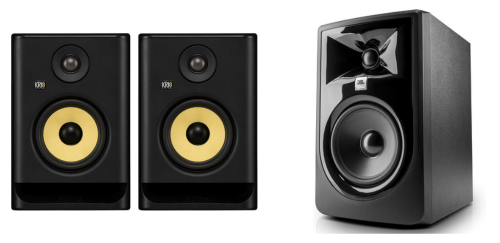
Why Do I Recommend The KRK Rokit 5?
- The KRK Rokit 5 G5 has DSP-based voicing presets for adapting the speaker response to different room acoustics and listening positions, while the JBL LSR305 uses basic analog boundary EQ switches with limited adjustment range.
- KRK Rokit 5 G5 comes with front-firing bass ports to maintain more consistent low-frequency performance when placed close to walls or on desks, whereas the JBL LSR305 uses rear-firing ports that are more sensitive to wall distance.
- It features extended high-frequency response up to 40 kHz for more accurate reproduction of harmonics and transient detail, while the JBL LSR305 is limited to a lower high-frequency cutoff.
- The KRK Rokit 5 G5 includes a digital control interface for precise level and EQ adjustments directly on the speaker, whereas the JBL LSR305 relies on traditional rear knobs and switches with less precision.
- KRK Rokit 5 G5 supports multiple onboard tuning profiles to match different production styles such as mixing, producing, or casual listening, while the JBL LSR305 uses a single reference voicing.
- It has automatic standby functionality to reduce power consumption during idle periods, while the JBL LSR305 requires manual power management.
- The KRK Rokit 5 G5 uses a redesigned cabinet and driver system aimed at lower distortion at moderate listening levels, whereas the JBL LSR305 uses an older cabinet and driver platform.
- KRK Rokit 5 G5 features front-panel visual feedback for setup and adjustment to simplify daily workflow, while the JBL LSR305 provides no visual interface beyond basic power indication.
Maybe the JBL LSR305 price can make you comfortable because it’s a little bit cheaper than the KRK Rokit 5. But you have to compromise all the above-mentioned features. Now the Decision is Yours. I hope it was helpful to choose the right one.
Side By Side Comparison
| Feature | KRK Rokit 5 | JBL LSR305 |
| LF cone material | Aramid glass composite (Rokit) | Composite |
| Rated frequency range | 43 Hz–40 kHz | 43 Hz–24 kHz |
| Port location | Front | Rear |
| Port style | Slot | Round/flared |
| Onboard tuning | DSP voicing / presets | Boundary EQ + HF trim switches |
| Room EQ presets | Yes | No |
| Front display / UI | Yes | No |
| Waveguide | KRK waveguide | JBL Image Control Waveguide |
| Input types | XLR, 1/4 in TRS | XLR, 1/4 in TRS |
| Input sensitivity control | Digital/encoder-based | Analog level knob |
| Auto standby | Yes | No |
| Cabinet height | Larger | Smaller |
| Cabinet depth | Different | Different |
| Weight | Heavier | Lighter |
| Price | Check KRK Rokit 5 Price | Check JBL LSR305 Price |
What Common Both Can Do?
- Active studio monitor: Both speakers use built-in amplification, meaning no external amplifier is required. This simplifies setup and ensures the amplifier is optimally matched to the drivers.
- Bi-amped design: Each model uses separate amplifiers for the woofer and tweeter. This improves clarity by allowing each driver to operate within its optimal frequency range.
- Nearfield design: Both monitors are tuned for close listening distances. This helps reduce room influence and improves accuracy when mixing at a desk or workstation.
- 5-inch low-frequency driver: Each speaker uses a 5-inch woofer, balancing compact size with usable low-end response. This makes them suitable for small to medium studio spaces.
- 1-inch high-frequency driver: Both models use a 1-inch tweeter for detailed high-frequency reproduction. This supports accurate monitoring of vocals, cymbals, and transients.
- Two-way system: Each speaker divides audio between a woofer and tweeter. This classic configuration improves phase coherence and tonal balance.
- Bass reflex enclosure: Both designs use ported cabinets to extend low-frequency output. This allows deeper bass than a sealed enclosure of similar size.
- Rear panel controls: Each monitor includes rear-mounted controls for level or tonal adjustment. This allows basic tuning to match room placement and listening preferences.
- Balanced inputs: Both support XLR and 1/4-inch TRS connections. Balanced inputs help reduce noise and interference in studio environments.
- Line-level input support: Each monitor accepts standard line-level audio signals. This ensures compatibility with audio interfaces, mixers, and controllers.
- Desktop/stand mounting: Both speakers are suitable for desk placement or speaker stands. Proper positioning helps achieve accurate stereo imaging.
- Rectangular MDF cabinet: Each uses an MDF enclosure to reduce unwanted resonances. This contributes to cleaner and more controlled sound reproduction.
- Magnetic shielding: Both monitors are designed to minimize magnetic interference. This allows safer placement near computers and other electronics.
- Stereo pair usage: Each model is intended to be used as a matched left/right pair. This is essential for accurate stereo imaging and panning decisions.
- Power status indicator: Both include a visual indicator showing when the speaker is powered on. This provides quick confirmation of operating status.
- Designed for mixing: Each monitor targets accurate, reference-style playback rather than consumer coloration. This helps users make reliable mixing and EQ decisions.
- Designed for home studios: Both speakers are popular choices for home and project studios. They balance affordability, size, and performance for everyday production work.
Common Features
| Feature | KRK Rokit 5 | JBL LSR305 |
| Speaker type | Active studio monitor | Active studio monitor |
| Amplification | Bi-amped | Bi-amped |
| Nearfield design | Yes | Yes |
| LF driver size | 5-inch | 5-inch |
| HF driver size | 1-inch | 1-inch |
| Two-way system | Yes | Yes |
| Bass reflex design | Yes | Yes |
| Rear panel controls | Yes | Yes |
| Balanced inputs | XLR, 1/4″ TRS | XLR, 1/4″ TRS |
| Line-level input support | Yes | Yes |
| Desktop/stand mounting | Yes | Yes |
| Rectangular MDF cabinet | Yes | Yes |
| Magnetic shielding | Yes | Yes |
| Stereo pair usage | Yes | Yes |
| Power status indicator | Yes | Yes |
| Designed for mixing | Yes | Yes |
| Designed for home studios | Yes | Yes |
| Price | Check KRK Rokit 5 Price | Check JBL LSR305 Price |