Samsung S10 Plus & OnePlus 7T share many similarities, but there are also important differences, such as quality, performance, features, design, and connectivity. If you want the best one between them, I Would recommend the Samsung S10 Plus rather than the OnePlus 7T.
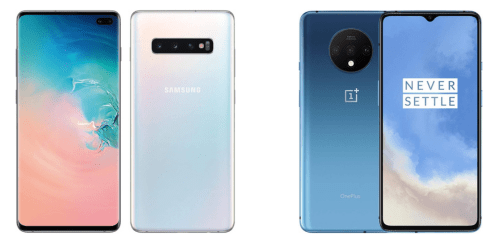
Why Do I Recommend The Samsung S10 Plus?
- The Samsung Galaxy S10 Plus features a QHD+ 3040×1440 AMOLED display for sharper text, finer details, and higher pixel density in reading, video, and VR use, while the OnePlus 7T uses a lower-resolution FHD+ 2400×1080 AMOLED display.
- Samsung Galaxy S10 Plus includes microSD card support for expandable storage flexibility to manage large media libraries and offline files, whereas the OnePlus 7T has no expandable storage support.
- It supports wireless charging for convenient cable-free top-ups on desks and bedside chargers, while the OnePlus 7T uses wired charging only.
- The Samsung Galaxy S10 Plus comes with reverse wireless charging for powering accessories like earbuds or another phone in emergencies, whereas the OnePlus 7T does not include reverse charging.
- Samsung Galaxy S10 Plus includes a 3.5mm headphone jack for direct compatibility with wired headphones and audio equipment without adapters, while the OnePlus 7T removes the headphone jack entirely.
- It features an ultrasonic in-display fingerprint sensor for more secure biometric unlocking that works better with wet or dirty fingers, while the OnePlus 7T uses an optical in-display fingerprint sensor.
- The Samsung Galaxy S10 Plus supports USB 3.1 data transfer speeds for faster file transfers, external storage access, and desktop connectivity, while the OnePlus 7T uses slower USB 2.0 speeds.
- Samsung Galaxy S10 Plus has an IP68 water and dust resistance rating for better protection against spills, rain, and submersion accidents, whereas the OnePlus 7T lacks an official IP rating.
Maybe the OnePlus 7T price can make you comfortable because it’s a little bit cheaper than the Samsung S10 Plus. But you have to compromise all the above-mentioned features. Now the Decision is Yours. I hope it was helpful to choose the right one.
Side By Side Comparison
| Feature | Samsung S10 Plus | OnePlus 7T |
| Display resolution | 3040×1440 | 2400×1080 |
| Panel branding | Dynamic AMOLED | Fluid AMOLED |
| In-display fingerprint | Ultrasonic | Optical |
| Front camera setup | Dual | Single |
| Chipset | Snapdragon 855 / Exynos 9820 | Snapdragon 855+ |
| Storage options | 128/512GB | 128/256GB |
| microSD | Yes | No |
| Battery | 4100mAh | 3800mAh |
| Wireless charging | Yes | No |
| Reverse wireless charging | Yes | No |
| Headphone jack | Yes | No |
| IP rating | IP68 | None |
| USB standard | USB 3.1 | USB 2.0 |
| Body size | 157.6×74.1×7.8mm | 160.9×74.4×8.1mm |
| Weight | 175g | 190g |
| Biometric extras | Face unlock + ultrasonic FP | Face unlock + optical FP |
| Price | Check Samsung S10 Plus Price | Check OnePlus 7T Price |
What Common Both Can Do?
- Display technology: Both devices use AMOLED panels, which provide deep blacks, vibrant colors, and excellent contrast. This display technology improves media consumption and overall visual quality.
- HDR support: Each phone supports HDR10+, allowing compatible content to display enhanced brightness, contrast, and color detail. This improves video playback quality on supported streaming platforms.
- Always-on display: Both models include an always-on display feature that shows time, notifications, and status icons with minimal battery usage. This allows quick information access without fully waking the phone.
- Rear camera count: Each device uses a triple-camera setup on the back, enabling multiple shooting perspectives. This design improves versatility for everyday photography.
- Ultra-wide camera: Both phones include an ultra-wide lens for capturing expansive scenes. This is useful for landscapes, group photos, and architecture shots.
- Telephoto camera: Each device includes a 2× telephoto lens, allowing optical zoom without significant quality loss. This helps with portrait shots and distant subjects.
- 4K video recording: Both support 4K video recording at up to 60 frames per second. This enables sharp, smooth video capture suitable for high-resolution displays.
- Front camera: Each phone has a dedicated front-facing camera for selfies and video calls. This ensures standard support for social media and communication apps.
- Stereo speakers: Both devices feature stereo speakers, providing louder and more immersive audio. This improves media playback and gaming without external speakers.
- USB-C port: Each model uses a USB-C connector for charging and data transfer. This allows compatibility with modern cables and accessories.
- Fast wired charging: Both phones support fast charging over a wired connection. This reduces downtime and allows quicker battery top-ups during daily use.
- In-display fingerprint sensor: Both devices integrate the fingerprint sensor under the display. This enables secure biometric unlocking without a rear or side-mounted sensor.
- Face unlock: Each phone supports face recognition as an additional biometric option. This provides a convenient alternative for unlocking the device quickly.
- Bluetooth: Both models support Bluetooth connectivity for wireless headphones, speakers, and accessories. This ensures compatibility with a wide range of devices.
- Wi-Fi: Each phone includes standard Wi-Fi support for fast wireless internet access. This is essential for streaming, downloads, and online services.
- NFC: Both devices include NFC, enabling contactless payments and quick device pairing. This adds convenience for modern digital transactions.
- Dual SIM support: Each phone supports dual SIM functionality in certain markets. This allows users to manage two phone numbers on a single device.
- Glass back design: Both smartphones use a glass back panel. This enables premium aesthetics and supports advanced features like wireless charging on compatible devices.
- Android OS: Both devices run Android as their operating system. This provides access to the Google Play ecosystem, regular app updates, and extensive customization options.
Common Features
| Feature | Samsung S10 Plus | OnePlus 7T |
| Display technology | AMOLED | AMOLED |
| HDR support | HDR10+ | HDR10+ |
| Always-on display | Yes | Yes |
| Rear camera count | Triple | Triple |
| Ultra-wide camera | Yes | Yes |
| Telephoto camera | Yes | Yes |
| 4K video recording | 4K@60fps | 4K@60fps |
| Front camera | Yes | Yes |
| Stereo speakers | Yes | Yes |
| USB-C port | Yes | Yes |
| Fast wired charging | Yes | Yes |
| In-display fingerprint sensor | Yes | Yes |
| Face unlock | Yes | Yes |
| Bluetooth | Yes | Yes |
| Wi-Fi | Yes | Yes |
| NFC | Yes | Yes |
| Dual SIM support | Yes | Yes |
| Glass back design | Yes | Yes |
| Android OS | Yes | Yes |
| Price | Check Samsung S10 Plus Price | Check OnePlus 7T Price |
FAQ
Is the Samsung Galaxy S10 Plus newer than the OnePlus 7T? Do both phones use AMOLED displays? Do the Samsung Galaxy S10 Plus and OnePlus 7T support HDR content? Do both phones have triple rear cameras? Do both phones include an ultra-wide camera? Is optical zoom available on both devices? Can both phones record 4K video? Do both phones have stereo speakers? Do both phones use USB-C for charging and data? Do both phones support fast wired charging? Do the Samsung Galaxy S10 Plus and OnePlus 7T have in-display fingerprint sensors? Is face unlock available on both phones? Do both phones support NFC? Do both phones support dual SIM functionality? Do both phones run Android? |