Sony A7C II & Sony A7 IV share many similarities, but there are also important differences, such as quality, performance, features, design, and connectivity. If you want the best one between them, I Would recommend the Sony A7C II rather than the Sony A7 IV.
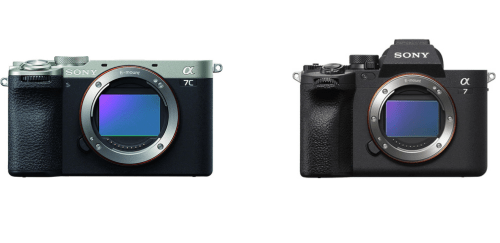
Why Do I Recommend The Sony A7C II?
- The Sony A7C II features a significantly smaller and lighter compact body for easier travel, everyday carry, and reduced fatigue during long handheld shoots, while the Sony A7 IV uses a larger and heavier traditional camera body.
- Sony A7C II includes a BIONZ XR + AI processing unit for more advanced subject recognition and faster real-time autofocus decisions, whereas the Sony A7 IV relies solely on the standard BIONZ XR processor.
- It comes with up to 7.0 stops of in-body image stabilization for sharper handheld photos and smoother handheld video, while the Sony A7 IV has a lower-rated 5.5-stop stabilization system.
- The Sony A7C II features improved AI-based subject detection modes such as birds and insects for more reliable wildlife and nature tracking, whereas the Sony A7 IV supports fewer AI-driven subject categories.
- Sony A7C II has a rangefinder-style body design for easier one-handed use and discreet street photography, while the Sony A7 IV uses a bulkier SLR-style layout.
- It delivers slightly longer rated battery life for extended shooting sessions without frequent battery changes, while the Sony A7 IV provides marginally lower battery endurance.
- The Sony A7C II supports a simpler and more compact control layout for faster casual shooting and travel workflows, whereas the Sony A7 IV uses a more complex control system designed for studio and professional rigs.
- Sony A7C II is better optimized for lightweight gimbal and vlog setups due to its smaller footprint and lower overall mass, while the Sony A7 IV requires larger stabilizers because of its heavier body.
Maybe the Sony A7 IV can make you comfortable because it’s a little bit cheaper than the Sony A7C II. But you have to compromise all the above-mentioned features. Now the Decision is Yours. I hope it was helpful to choose the right one.
Side-by-Side Comparison
| Feature | Sony A7C II | Sony A7 IV |
| Processor | BIONZ XR + dedicated AI processing unit | BIONZ XR |
| Battery rating (CIPA, typical) | Approx. 530 shots | Approx. 520 shots |
| Body style | Rangefinder-style | SLR-style center EVF hump |
| Weight (with battery + card) | Approx. 514 g | Approx. 658 g |
| Viewfinder placement | Left-corner EVF | Center EVF |
| EVF size | 0.39″ | 0.5″ |
| HDMI port | Micro HDMI | Full-size HDMI |
| In-body stabilization rating | Up to 7.0 stops | Up to 5.5 stops |
| Top/drive mode control | 3-way Still/Movie/S&Q switch | Dedicated Still/Movie/S&Q dial |
| Grip/handling space | Compact grip/body clearance | Larger grip/body clearance |
| Price | Check Sony A7C II Price | Check Sony A7 IV Price |
What Common Both Can Do?
- Full-frame Sensor: Both cameras use a full-frame sensor, which allows for better low-light performance and greater control over depth of field. This sensor size is important for photographers and videographers seeking high image quality and professional results.
- 33 MP Resolution: Each model features a 33-megapixel sensor, providing high detail for large prints and flexible cropping. This resolution balances detail with manageable file sizes for everyday workflows.
- Exmor R CMOS Sensor: Both use Sony’s backside-illuminated Exmor R CMOS technology, which improves light-gathering efficiency. This helps maintain cleaner images at higher ISO values.
- BIONZ XR Processor: The same BIONZ XR processor powers both cameras, enabling fast readout, responsive operation, and advanced autofocus calculations. This processor is key to handling high-resolution images and 4K video smoothly.
- Sony E-mount: Both cameras use the Sony E-mount, ensuring compatibility with Sony’s full range of native lenses and third-party options. This gives users flexibility to expand their kit without changing systems.
- In-Body Image Stabilization: Each model includes in-body image stabilization, helping reduce blur from camera shake. This is especially useful for handheld shooting in low light or when using non-stabilized lenses.
- 5-Axis IBIS: The stabilization system in both cameras compensates across five axes. This improves sharpness for both still photos and handheld video.
- Hybrid Autofocus System: Both cameras combine phase-detection and contrast-detection autofocus. This hybrid approach improves accuracy, speed, and reliability across different shooting conditions.
- 759 Phase-Detect AF Points: Each camera uses 759 phase-detect autofocus points covering most of the frame. Wide coverage helps maintain focus on subjects even when they move toward the edges.
- Real-time Eye AF: Both support Real-time Eye AF for humans and animals. This feature ensures consistent focus on eyes, which is critical for portraits and action shots.
- Real-time Subject Tracking: Advanced subject tracking is available on both models. This allows the camera to follow moving subjects smoothly during continuous shooting or video recording.
- Up to 10 fps Burst Shooting: Both cameras can shoot at up to 10 frames per second. This makes them suitable for capturing action, sports, and fast-moving subjects.
- ISO 100–51,200: The native ISO range is the same on both models, offering flexibility in a wide variety of lighting conditions. This range supports both bright daylight and challenging low-light scenes.
- 4K Video Recording: Each camera supports 4K UHD video recording. This resolution is ideal for high-quality video production and future-proof content creation.
- S-Log3 and S-Cinetone Profiles: Both cameras include professional picture profiles like S-Log3 and S-Cinetone. These profiles provide greater dynamic range and more flexible color grading options.
- Vari-angle Touchscreen LCD: A fully articulating touchscreen is present on both models. This makes them convenient for vlogging, low-angle shots, and self-recording.
- NP-FZ100 Battery: Both use the same NP-FZ100 battery. This allows users to share batteries and chargers between the two cameras.
- USB-C Charging: USB-C support on both cameras enables in-camera charging and power delivery. This is useful for travel and extended shooting sessions.
- Wireless Connectivity: Wi-Fi and Bluetooth are included on both models for image transfer and remote control. These features simplify sharing and remote operation.
- Weather Sealing: Both cameras feature weather-resistant construction. This helps protect them when shooting in light rain, dust, or challenging outdoor environments.
Common Features
| Feature | Sony A7C II | Sony A7 IV |
| Sensor format | Full-frame | Full-frame |
| Sensor resolution | 33 MP | 33 MP |
| Sensor type | Exmor R CMOS | Exmor R CMOS |
| Image processor | BIONZ XR | BIONZ XR |
| Lens mount | Sony E-mount | Sony E-mount |
| In-body image stabilization | Yes | Yes |
| IBIS axes | 5-axis | 5-axis |
| Autofocus system | Hybrid phase + contrast AF | Hybrid phase + contrast AF |
| AF points (phase detect) | 759 points | 759 points |
| Real-time Eye AF | Yes | Yes |
| Real-time subject tracking | Yes | Yes |
| Continuous shooting | Up to 10 fps | Up to 10 fps |
| ISO range (native) | 100–51,200 | 100–51,200 |
| Video resolution | 4K UHD | 4K UHD |
| Log profiles | S-Log3 / S-Cinetone | S-Log3 / S-Cinetone |
| LCD screen | Vari-angle touchscreen | Vari-angle touchscreen |
| Battery type | NP-FZ100 | NP-FZ100 |
| USB charging | USB-C | USB-C |
| Wi-Fi & Bluetooth | Yes | Yes |
| Weather sealing | Yes | Yes |
| Price | Check Sony A7C II Price | Check Sony A7 IV Price |
FAQ
Are the Sony A7C II and Sony A7 IV using the same sensor? Do both cameras share the same image processor? Is autofocus performance similar on both cameras? Do both cameras support Eye AF for humans and animals? Can both cameras shoot at the same burst speed? Do both cameras record 4K video? Are S-Log3 and S-Cinetone available on both cameras? Do both cameras have in-body image stabilization? Is the LCD screen type the same on both cameras? Do the Sony A7C II and Sony A7 IV use the same battery? Can both cameras be charged via USB-C? Is wireless connectivity the same on both cameras? Do both cameras support the Sony E-mount lens system? Are both cameras weather-sealed? Is image quality comparable between the two cameras? |